Drawing register

Proof, framed by what it demonstrates

A club platform is multi-tenant SaaS engineering. A drawing set becoming a priced bill is document intelligence. Read these for the engineering underneath rather than the industry on top, because the industry on top is the part least likely to be yours.

Five pieces of work: three live, one a prototype and one a proof of concept. Nothing here is described as more finished than it is. What each word means.

Sheet
A-01
Title
Work
Issued for
Information
Drawn by
Snilld

Adoption across a very wide user baseMembership and hospitalityLive
Preview · W-016 screens
The home screen of an invented demo club: a greeting to the member, an illustration of the clubhouse and its courts, and the member’s next booking.
01 / 06The club, on a member’s phone
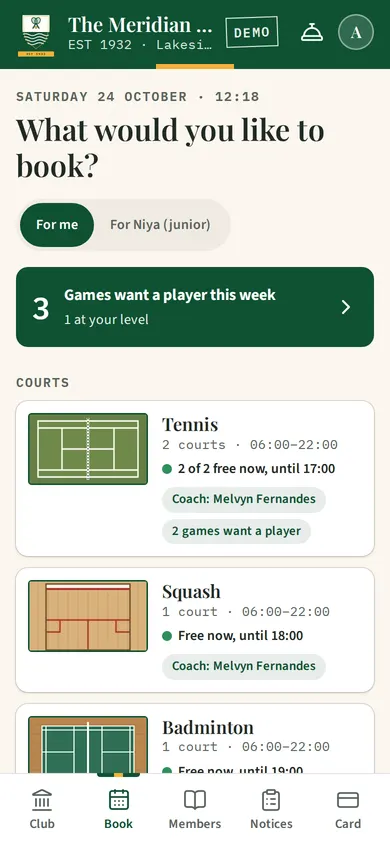
A booking screen listing the tennis, squash and badminton courts with what is free now, the coach for each, and games that want a player.
02 / 06Book a court
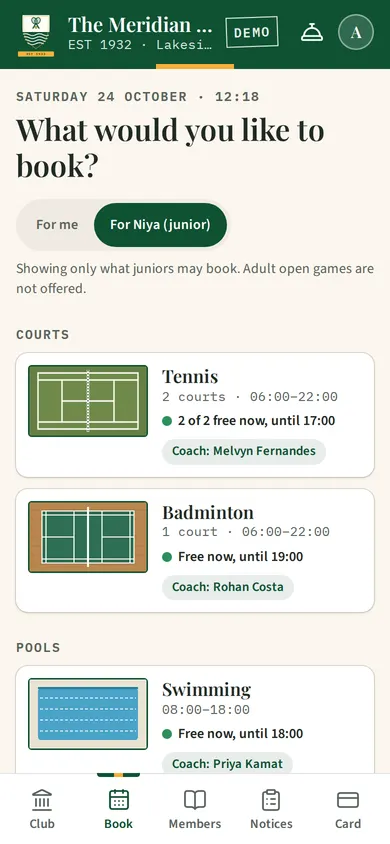
The same booking screen switched to a junior member, showing only what juniors may book and saying that adult open games are not offered.
03 / 06Booking for a child
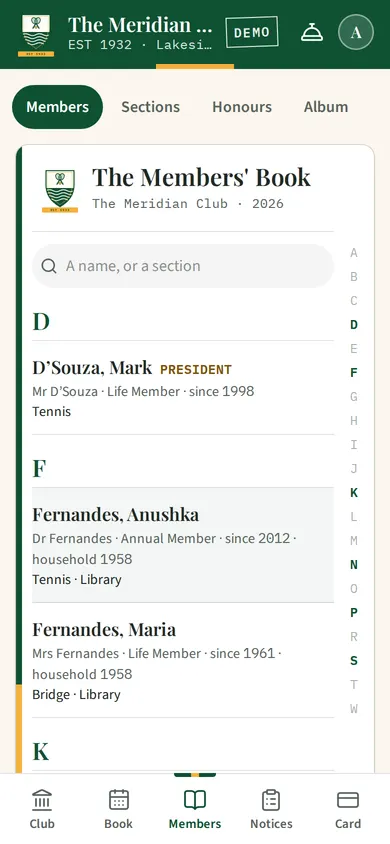
The members’ book: an alphabetical directory of invented members with their membership type, the year they joined and their sections.
04 / 06The members’ book
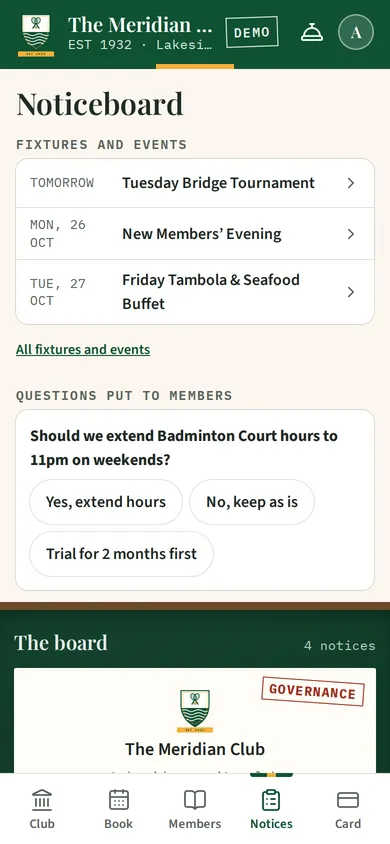
The noticeboard: upcoming fixtures, and a question put to members about extending court hours, with three answers to choose from.
05 / 06Notices, and a question put to members
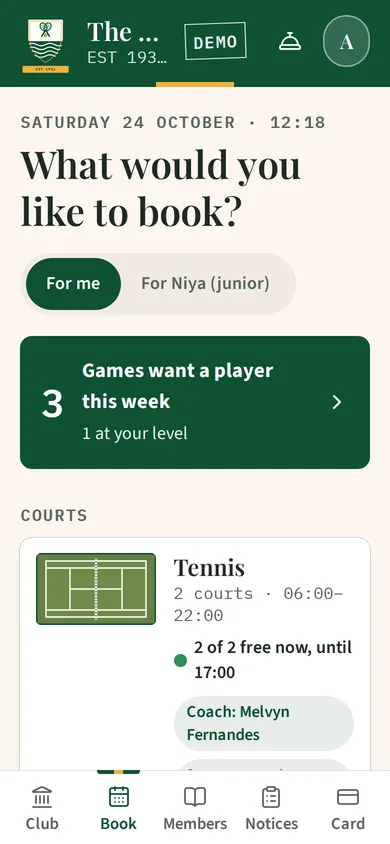
The booking screen in large-text mode, with bigger headings, labels and buttons.
06 / 06Large text, for older members

Demo data. Every name and number is invented.

Read sheet W-01 ↓

Sheet W-01 · Adoption across a very wide user base · Membership and hospitality

Live

Our operating system for members’ clubs: court booking, dining, guests, directory and committee governance, built for a membership whose youngest user is nine and oldest is ninety.
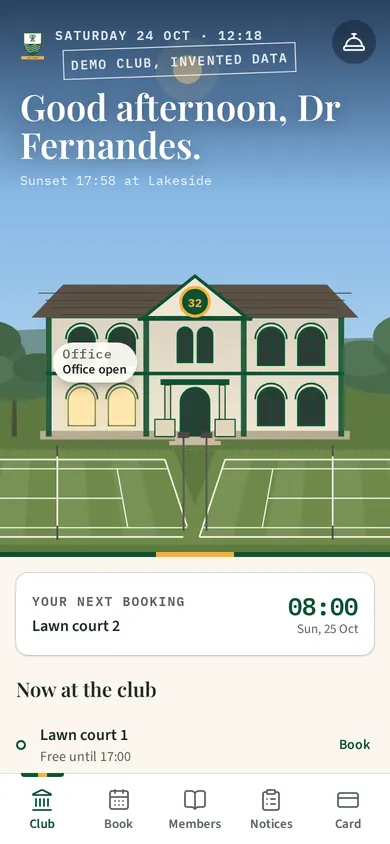
The home screen of an invented demo club: a greeting to the member, an illustration of the clubhouse and its courts, and the member’s next booking.
01 / 06The club, on a member’s phone
A booking screen listing the tennis, squash and badminton courts with what is free now, the coach for each, and games that want a player.
02 / 06Book a court
The same booking screen switched to a junior member, showing only what juniors may book and saying that adult open games are not offered.
03 / 06Booking for a child
The members’ book: an alphabetical directory of invented members with their membership type, the year they joined and their sections.
04 / 06The members’ book
The noticeboard: upcoming fixtures, and a question put to members about extending court hours, with three answers to choose from.
05 / 06Notices, and a question put to members
The booking screen in large-text mode, with bigger headings, labels and buttons.
06 / 06Large text, for older members

Demo data. Every name and number is invented.

Goes in
A noticeboard, a phone call, and a secretary who remembers everything
What we built
Booking, announcements, an open-play partner board, a directory and guest passes
Comes out
A member does it on their own phone — in large-text mode or kids mode if they need it
The line it does not cross
Each club is isolated by Postgres row-level security, not by application code alone

Note 1 · The constraint

A heritage private members’ club in Goa with more than 2,500 members runs on a noticeboard, a phone call and a secretary who remembers everything. Existing club software is priced for the United States and assumes members who will happily learn a new app. Most of this membership will not.

Note 2 · What transfers

The discipline that decides whether a shop floor, a depot or a field team actually uses what you commissioned. Most systems in this bracket fail on adoption rather than on features.

Members at launch club
2,500+
Client
Anonymised
Isolation
Postgres row-level security
Hosting
Oracle Cloud, India region
Accessibility
WCAG 2.2 AA as the floor
Interactive demo
Public, no sign-up

Legend

How to read this register

Four status words and two rules. The words are load-bearing: each one is a claim about how finished something is, and we use them literally.

Live
Running in production and used by people who are not us. If it says live, you can look at it.
In build
Being built now, with a client, against a date. Some of what is described is working and some of it is not finished.
Prototype
Demonstrates a design rather than carrying real load. Where the stored state is simulated instead of a production database, the facts panel says so.
Proof of concept
Proves the hard part works on real inputs. It is not a product and it is not in production.
Clients
Anonymised. No client is named unless they have given written permission, so most entries describe the organisation rather than naming it. The constraint and the engineering are described exactly as they are.
Numbers
No accuracy or confidence figure appears anywhere on this page, because none has been measured under conditions we would be willing to publish.